
Amazon Agency vs. Distributor: Which Model Fits Your Business?
Manufacturers do not need an internal Amazon team to grow the channel. The right partner model depends on inventory ownership, decision-making capacity, and unit economics.
A manufacturer can grow on Amazon without hiring an internal marketplace team. The harder question is not whether to outsource. It is what kind of partner relationship the business actually needs.
For most manufacturers, the choice comes down to two models: hiring a full-service Amazon agency to manage the channel or working with an Amazon distributor that purchases inventory and operates the channel. Both can remove a major staffing burden, but they solve different problems and place different responsibilities on the manufacturer.
Choosing between an Amazon agency and a distributor requires more than comparing a monthly retainer with a wholesale purchase order. The manufacturer must decide who should own the inventory, who should control the Amazon account, who will make recurring channel decisions, and whether the product has enough margin to support the structure.
When those questions are answered honestly, the right operating model usually becomes much clearer.
Why Manufacturers Do Not Always Need an Internal Amazon Team
Running Amazon well involves far more than uploading a product and turning on advertising. A healthy channel requires catalog management, listing optimization, advertising strategy, inventory planning, FBA coordination, account health monitoring, case management, pricing decisions, review strategy, reporting, and constant troubleshooting.
An internal team can provide direct control and close alignment with the rest of the business. It can also be expensive and difficult to build. A manufacturer may need several specialized roles before the channel is large enough to justify the payroll, tools, training, and management time. Even then, the team still has to keep pace with marketplace changes.
Outsourcing gives the manufacturer access to established systems and marketplace experience without recreating every function internally. The important distinction is that outsourcing Amazon management and outsourcing Amazon ownership are not the same decision.
The Two Amazon Partner Models at a Glance
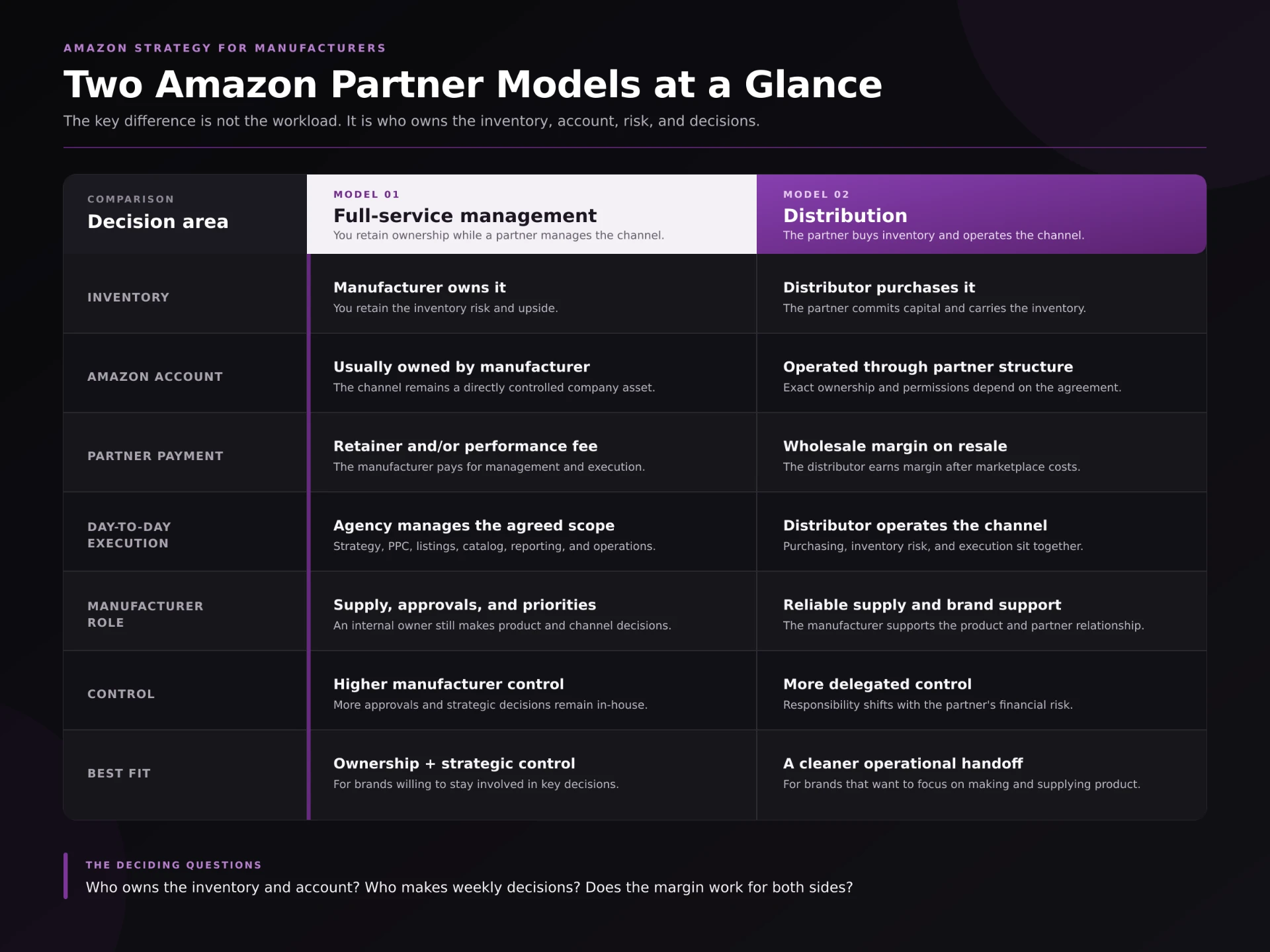
Comparison of full-service Amazon management and distribution partner models.
When Full-Service Amazon Management Is the Better Fit
In a full-service management relationship, the manufacturer generally keeps ownership of its inventory, brand assets, and Amazon account. The agency manages the channel on the manufacturer's behalf within an agreed scope. That scope often includes strategy, PPC, listing content, catalog maintenance, promotions, FBA planning, reporting, and operational problem-solving.
This model tends to work best in three situations.
You want to preserve account and inventory ownership.
Some manufacturers want Amazon to remain a company-owned sales channel. They want customer and sales data to stay connected to their account, and they want direct control over pricing, brand presentation, and long-term channel strategy. Full-service management allows the company to keep that ownership while bringing in specialists to execute the work.
Your unit economics can support professional management.
A management fee should never be evaluated in isolation. Start with the complete contribution margin: selling price, landed product cost, referral fees, fulfillment or shipping, storage, advertising, returns, promotions, and the management fee. Then test the model at realistic sales volumes rather than an optimistic growth target.
A product can generate attractive revenue and still be a poor Amazon opportunity if advertising and marketplace costs consume the available margin. The agency relationship works when the channel can fund the work and still produce a return for the manufacturer.
Someone inside the company can still make decisions.
An agency can own execution, but it cannot replace every manufacturer-side decision. Someone inside the business still needs authority to approve inventory plans, answer product questions, resolve supply problems, review major pricing changes, and decide which products or priorities come first.
This does not require a full internal Amazon team. It usually requires one accountable stakeholder who can make timely decisions and coordinate the necessary people inside the company. Without that person, even a strong agency can be slowed by unanswered questions and delayed approvals.
When an Amazon Distribution Partner Is the Better Fit
In a distribution model, the partner purchases inventory from the manufacturer and resells it on Amazon. Instead of paying a retainer for channel management, the manufacturer earns wholesale revenue while the distributor takes responsibility for inventory risk, marketplace costs, and day-to-day execution.
Distribution can be the stronger model when the manufacturer wants a more complete handoff.
Your team does not want to staff or operate Amazon.
Some companies recognize the Amazon opportunity but do not want to add marketplace operations to their internal workload. They want to focus on manufacturing, product development, and supply. A distributor can create a clearer division of responsibility: the manufacturer makes and supplies the product, while the partner buys inventory and operates the channel.
The product has enough margin for both businesses.
Distribution only works when the economics support two healthy businesses. The distributor must cover the wholesale purchase price, Amazon fees, fulfillment, storage, advertising, returns, operational labor, and inventory risk. The manufacturer must still earn an acceptable margin at the wholesale price.
If the wholesale price leaves too little contribution margin for marketplace costs, the distributor cannot invest enough to grow the product responsibly. If the purchase price is pushed too low, the manufacturer may gain sales but lose the economics that made the relationship worthwhile.
You are comfortable delegating more control.
A distribution relationship generally gives the operating partner more control over purchasing, inventory timing, channel execution, and sometimes pricing within agreed brand guidelines. That tradeoff can be valuable because responsibility and financial risk move together. It can also be uncomfortable for a manufacturer that wants to approve every campaign or tactical decision.
The strongest distribution partnerships define expectations early: authorized seller status, channel exclusivity when appropriate, brand standards, pricing policies, inventory commitments, reporting, account access, content ownership, and what happens if the relationship ends.
Three Questions That Usually Decide the Model
Who should own the inventory and Amazon account?
Ownership affects control, cash flow, risk, and the ability to change partners later. If the manufacturer wants Amazon to remain a directly owned company asset, management is usually the cleaner fit. If the manufacturer wants wholesale orders and fewer marketplace responsibilities, distribution may be more appropriate.
Who will make the decisions Amazon requires every week?
Amazon creates recurring decisions around advertising, pricing, inventory, catalog issues, promotions, compliance, returns, and customer feedback. Under a management model, the agency can recommend and execute, but the manufacturer still owns many final decisions. Under distribution, the partner can take on more of that responsibility because it owns the inventory and marketplace risk.
Does the structure leave enough margin for everyone?
The correct model must leave enough margin for the product, the manufacturer, and the partner. Build the economics from the unit level upward. Include costs that are easy to overlook, such as aged inventory, inbound freight, returns, promotional discounts, content production, compliance work, and the advertising required to gain visibility.
If the numbers only work when conversion rates are unusually high or advertising costs are unusually low, the plan is fragile. A realistic model should absorb normal marketplace volatility.
Common Mistakes Manufacturers Make When Outsourcing Amazon
- Choosing based only on the fee. A lower retainer or a higher wholesale price does not automatically create a better total return.
- Assuming outsourcing removes every internal responsibility. Even distribution requires reliable supply, accurate product information, brand cooperation, and clear escalation paths.
- Skipping the unit-economics model. Revenue projections are not useful until marketplace costs and partner economics are included.
- Leaving ownership terms vague. Account access, content, reviews, inventory, trademarks, Brand Registry roles, and exit rights should be understood before work begins.
- Expecting activity to fix poor product fit. More advertising cannot permanently overcome weak demand, uncompetitive pricing, low margin, or a product page that cannot convert.
When Neither Model Is Ready to Work
Sometimes the right answer is not management or distribution. It is fixing the product and channel economics first. Warning signs include insufficient margin, inconsistent supply, unclear brand ownership, unresolved compliance issues, a product that is not competitive in its category, or leadership expectations that depend on immediate profit and immediate growth at the same time.
In those cases, the business may need a narrower launch plan, different packaging, a pricing change, better channel enforcement, a limited catalog test, or more operational preparation before committing to a full growth program. Amazon needs a viable plan before it needs more activity.
How to Evaluate an Amazon Agency or Distributor
Before signing an agreement, ask potential partners to explain:
- Scope. What work is included, what is excluded, and who owns each recurring responsibility?
- Economics. How does the partner make money, and what assumptions are being used for advertising, returns, fees, and inventory?
- Ownership. Who owns the account, listings, creative assets, data, and remaining inventory?
- Decision rights. Which decisions can the partner make independently, and which require manufacturer approval?
- Reporting. What will be reported, how often, and how will profitability be measured?
- Exit plan. What happens to account access, content, inventory, and channel operations if the relationship ends?
A capable partner should be willing to discuss where the model does not fit, not only where it does. That conversation is often more valuable than a broad promise to grow sales.
The Right Amazon Model Depends on the Responsibility You Want to Keep
A full-service Amazon agency is not automatically the right answer because it preserves ownership. Distribution is not automatically better because it removes staffing pressure. The better model depends on product fit, margin structure, internal capacity, and how much channel responsibility the manufacturer actually wants to retain.
Manufacturers that want direct ownership and can support timely internal decisions often benefit from full-service management. Manufacturers that prefer wholesale revenue and a clearer operational handoff may be better suited to distribution. In both cases, the partnership must be built on realistic economics and clearly assigned responsibilities.
Barrel Aged E-Commerce works with manufacturers through both full-service Amazon management and selective distribution relationships. If you are evaluating which model fits your products, we can review the channel economics, operating requirements, and ownership tradeoffs before recommending a structure.
Frequently Asked Questions
What is the difference between an Amazon agency and an Amazon distributor?
An Amazon agency manages the channel for the manufacturer, usually while the manufacturer retains ownership of the inventory and account. An Amazon distributor purchases inventory and resells it, taking on more financial risk and day-to-day operating responsibility.
Is an Amazon agency cheaper than hiring an internal team?
It often can be, especially before Amazon revenue can support several dedicated specialists. The comparison should include payroll, benefits, tools, creative resources, recruiting, training, and management time — not only salaries.
Does a distributor own the Amazon listing?
Not necessarily. Listing and brand control depend on the account structure, Brand Registry permissions, seller authorization, and the agreement between the parties. These rights should be documented before launch.
Can a manufacturer switch from agency management to distribution later?
Yes, if account ownership, content ownership, inventory, data access, and exit terms have been handled correctly. Many manufacturers adjust their operating model as the channel and internal priorities change.
How do I know whether my product has enough margin for Amazon?
Build a unit-level model that includes landed cost, Amazon referral and fulfillment fees, storage, inbound freight, advertising, returns, promotions, partner compensation, and a buffer for normal volatility. Test the result at realistic sales and conversion levels.
- See how we handle this work day to day in our Amazon services.
- Want the numbers? Read the case studies.
- Ready to talk? Book a 20-minute account review.