
Your Amazon Listing Dimensions May Be Correct—and Your FBA Fees May Still Be Wrong
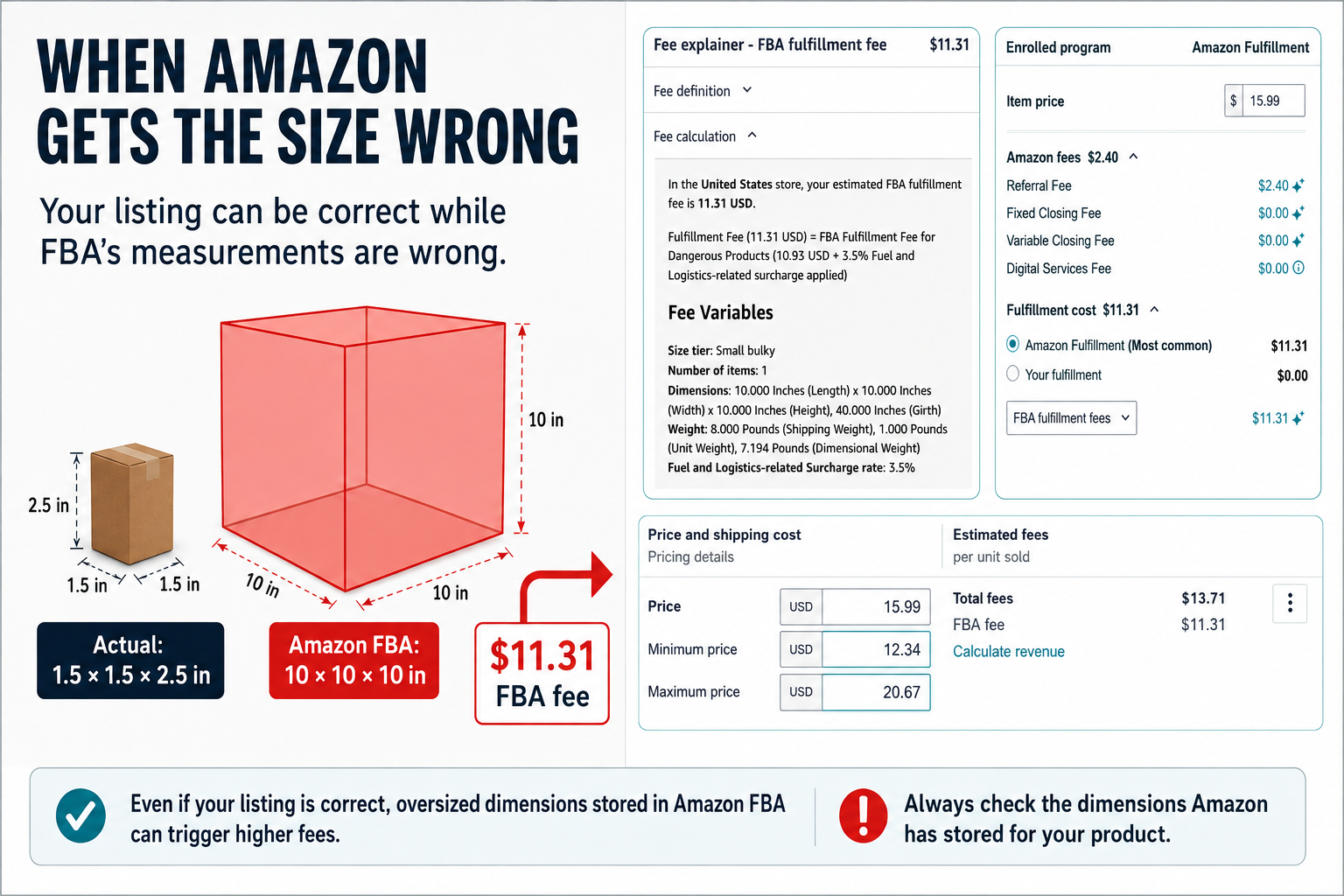
Amazon may store a different set of product measurements than the ones in your listing backend. We found a 1.5 × 1.5 × 2.5 inch product recorded as a 10-inch cube, carrying an $11.31 FBA fee on a $15.99 item.
Amazon sellers spend a lot of time monitoring advertising costs, conversion rates, inventory levels, and listing performance. But one of the easiest places to lose money is often hidden in plain sight: the dimensions and weight Amazon uses to calculate FBA fees.
The important distinction is that Amazon may have more than one set of product measurements associated with an ASIN.
The dimensions entered in the backend of your listing can be completely correct while the measurements stored by Amazon FBA are wrong. When that happens, Amazon may classify the product in a larger size tier, assign an excessive shipping weight, and charge a much higher fulfillment fee on every unit sold.
Unless you deliberately check the fee calculation, you may never notice.
A small product with a very large measurement problem
We recently found this issue on a product measuring approximately 1.5 × 1.5 × 2.5 inches.
However, Amazon FBA had recorded the product as 10 × 10 × 10 inches.
That is not a minor difference.
Amazon's system treated a product small enough to fit in the palm of your hand as though it occupied a 1,000-cubic-inch box. Based on those stored measurements, Amazon placed the product in the "small bulky" size tier and assigned it a shipping weight of eight pounds.
The resulting FBA fulfillment fee was $11.31 per unit.
The item sold for $15.99. After adding the $2.40 referral fee, Amazon's estimated fees totaled $13.71 per sale—before considering the cost of the product, inbound freight, advertising, storage, or any other operating expense.
A profitable product can quickly become unprofitable when Amazon charges an incorrect fulfillment fee on every order.
The most frustrating part was that the dimensions in the listing backend were correct. A routine listing audit would not necessarily have uncovered the problem. We had to examine the dimensions Amazon FBA was actually using in its fee calculation.
Why correct listing data is not enough
Many sellers assume that the dimensions entered under a listing's product details are the same dimensions Amazon uses to calculate fulfillment fees.
That is not always the case.
Amazon may measure products after inventory arrives at a fulfillment center. Those measurements can become part of the data used to determine the product's size tier, dimensional weight, shipping weight, and fulfillment fee.
This means there can be a disconnect between two sets of information:
- The dimensions shown or entered in the listing backend
- The dimensions and weight Amazon FBA uses for fee calculations
Updating the product detail page does not guarantee that the FBA measurements will also be corrected. Likewise, a listing may continue showing accurate dimensions while the fee system quietly uses something entirely different.
Incorrect measurements can result from a measuring error, packaging differences, bundled units, label placement, inventory preparation, or another issue in Amazon's fulfillment process. The cause is not always obvious.
What matters is the result: Amazon calculates fees using the measurements stored in its FBA system, not simply the numbers you believe are attached to the listing.
Small errors become expensive at scale
An incorrect fee can look like a minor account issue until you calculate its cumulative effect.
If Amazon overcharges a product by $3 per unit and you sell 500 units per month, that is $1,500 in unnecessary monthly fees. At 2,000 units per month, the same error costs $6,000 each month.
In the example above, the fee represented more than 70% of the item's selling price. Even a fraction of that overcharge would materially affect the product's profitability.
These errors can also distort the rest of your decision-making.
You may believe that advertising is unprofitable when the real problem is an inflated fulfillment fee. You might raise the price, reduce bids, discontinue a campaign, slow down inventory purchases, or even abandon an otherwise successful product.
Your reporting can be accurate while the underlying fee is wrong.
That is why fee verification should be treated as part of regular account management—not something you only investigate after margins collapse.
What sellers should check
Start by reviewing the FBA fee Amazon is charging for each product. Do not stop at the total fee. Open the fee explanation and inspect the variables used in the calculation.
Compare the following information with the product and its prepared packaging:
- Length, width, and height
- Unit weight
- Shipping weight
- Dimensional weight
- Product size tier
- Fulfillment fee per unit
- Any additional program or category-related surcharges
Use the exact condition in which the product is sent to Amazon. If it arrives in a poly bag, box, protective wrap, or other required preparation, measure the fully prepared unit rather than the bare product.
Pay particular attention to products near the boundary between size tiers. A relatively small measurement difference can sometimes move an item into a more expensive classification.
Large discrepancies, such as a 2.5-inch product being recorded as 10 inches on every side, should stand out immediately. Smaller errors can be harder to detect but may still have a meaningful financial impact.
How often should you review FBA measurements?
This should not be a one-time audit.
Amazon can remeasure inventory, and the measurements associated with a product can change after you have already verified them. A product that was correct six months ago may not still be correct today.
At a minimum, review FBA dimensions and fees:
- When launching a new product
- After the first inventory is received
- After changing packaging
- After creating a bundle or multipack
- When an FBA fee changes unexpectedly
- When a product moves into a different size tier
- When profitability drops without a clear explanation
- After Amazon performs a remeasurement
- During a recurring monthly or quarterly fee audit
High-volume products deserve the most frequent attention because even a small overcharge can create a large loss. However, slower-selling products should not be ignored. An excessive fee can prevent them from ever becoming profitable enough to scale.
A simple recurring spreadsheet can help. Track each ASIN's expected dimensions, Amazon's stored dimensions, expected weight, current size tier, fulfillment fee, date reviewed, and any action taken.
This turns an easily overlooked problem into a repeatable operating process.
What to do when the measurements are wrong
If you find a discrepancy, document everything before opening a case.
Take clear photographs of the product next to a ruler or measuring tape. Show the length, width, and height separately. Photograph the product on a scale, and make sure the displayed weight is visible. The product identifier and packaging should also be recognizable.
Then request that Amazon remeasure the FBA inventory.
In the case, clearly state:
- The ASIN and FNSKU
- The dimensions Amazon is currently using
- The product's actual packaged dimensions
- The current recorded weight
- The actual packaged weight
- The fee being charged
- The requested correction
Keep the explanation concise and attach the supporting images when possible.
After Amazon completes the remeasurement, do not assume the issue is resolved. Return to the fee calculation and verify that the dimensions, weight, size tier, and fulfillment fee have actually changed.
If Amazon confirms that incorrect measurements caused an overcharge, review whether the affected transactions may qualify for reimbursement under Amazon's current policies. Eligibility and available lookback periods can vary, so verify the applicable rules rather than assuming every past fee will be refunded.
Continue monitoring the ASIN afterward. A corrected measurement can occasionally change again.
Protecting profit requires looking beyond sales
Amazon sellers naturally focus on growing revenue. But revenue growth does not matter if preventable fees are quietly consuming the margin.
The product in this example was only 1.5 × 1.5 × 2.5 inches. Amazon FBA had it stored as 10 × 10 × 10 inches and calculated an $11.31 fulfillment fee. The backend listing information was correct, but the fee calculation was not.
That is the lesson.
Do not assume your FBA measurements are correct because your listing is correct. Do not assume a familiar fee is an accurate fee. And do not wait for a product to become unprofitable before investigating.
Check the measurements Amazon is actually using. Compare them with the prepared product in your warehouse. Document discrepancies, request remeasurement, verify the correction, and repeat the process regularly.
Sometimes improving profitability does not require more sales or lower advertising costs. Sometimes it starts by finding out why Amazon thinks a tiny product is a 10-inch cube.
- See how we handle this work day to day in our Amazon services.
- Want the numbers? Read the case studies.
- Ready to talk? Book a 20-minute account review.